Most people understand stress as a mental or emotional experience — something that happens in the mind and produces psychological symptoms. What they do not realize is that stress is also a deeply physical event, one that plays out in real time across their muscles, their breathing, their nervous system, and their posture.
This relationship runs in both directions. Chronic stress shapes the body into a pattern of physical tension that we read as poor posture. And poor posture, once established, generates a physiological stress state that the mind then interprets as anxiety, irritability, or fatigue. Breaking this cycle requires understanding both directions — and addressing them at their physical root.
How Stress Shapes the Body
The Stress Response and Muscle Tension
When your nervous system detects a threat — real or perceived — it triggers the sympathetic stress response. Cortisol and adrenaline are released. Heart rate rises. Breathing shallows. And your muscles contract, particularly the muscles of the neck, shoulders, jaw, and upper back. This muscular contraction is part of the defensive posture that prepares the body to fight or flee.
In an acute stressor — a sudden fright or physical danger — this contraction is brief and resolves when the threat passes. But in the context of chronic workplace stress, deadline pressure, or emotional strain, this muscular tension becomes sustained. The muscles never fully release. Over weeks and months, this creates the postural pattern that most desk workers recognize: elevated and internally rotated shoulders, forward head carriage, collapsed chest, and a flattened or reversed lumbar curve.
This is a single integrated process — not two separate problems, but one pattern with two faces.
How Does Tension and Stress Affect Posture Specifically?
When people ask how does tension and stress affect posture, the answer involves several overlapping mechanisms:
Muscle guarding: Chronic tension in the upper trapezius, levator scapulae, and suboccipital muscles pulls the head and shoulders forward and up. The longer this tension is maintained, the more the soft tissue adaptively shortens — making the forward head and rounded shoulder posture increasingly structural rather than just muscular.
Breathing restriction: The stress response promotes shallow, upper-chest breathing. This pattern keeps the respiratory accessory muscles — the scalenes, sternocleidomastoid, and upper trapezius — chronically active, adding to upper body tension and reinforcing the collapsed chest posture that prevents deep breathing.
Cortisol and connective tissue: Chronically elevated cortisol impairs collagen synthesis and promotes inflammation in connective tissue. Over time, this reduces the elasticity of the fascia and ligaments that support upright posture — making stress-induced postural collapse increasingly resistant to correction.
Psychological withdrawal: High stress states are associated with self-protective body language — hunching, crossing arms, making the body smaller. This psychological contraction becomes physical habit when it is repeated for hours each day.
How Bad Posture Amplifies Stress
Bad posture and stress do not simply coexist — bad posture actively generates and maintains a physiological stress state. This is the dimension of the relationship that most people miss entirely.
Shallow Breathing and Cortisol
A slouched posture compresses the diaphragm and forces shallow thoracic breathing — the same breathing pattern that activates the sympathetic nervous system. Research in psychophysiology consistently shows that respiratory rate and pattern are primary signals to the nervous system about whether the body is safe or threatened. Shallow, rapid chest breathing signals threat. Deep, slow diaphragmatic breathing signals safety.
When your posture forces you to breathe shallowly for eight hours a day, your nervous system receives eight hours of low-grade threat signals. Cortisol remains elevated. The stress response stays partially activated. Poor posture and stress feed each other in a continuous loop that willpower alone cannot break.
The Embodied Stress Signal
Body posture and stress are linked through a phenomenon that psychologists call embodied cognition — the finding that body position directly influences emotional experience, not just the other way around. Research has shown that collapsed, closed postures generate feelings of helplessness, low energy, and emotional vulnerability. Upright, open postures generate feelings of confidence, competence, and calm.
This means that sitting in a collapsed posture for the majority of your workday is not merely a physical problem — it is continuously generating an emotional state of reduced resilience and elevated stress reactivity. The body is not just reflecting stress; it is producing it.
Pain as a Stressor
Poor posture generates physical pain — neck tension, upper back ache, lower back discomfort, and headaches are all direct consequences of the structural strain that poor alignment creates. Pain is one of the most powerful activators of the stress response. Every hour spent in a posture that generates discomfort is an hour of elevated cortisol, heightened emotional reactivity, and reduced cognitive performance.
This pain-stress feedback loop is why so many desk workers feel mentally drained as well as physically uncomfortable by midday — their chair has been running both loops simultaneously since they sat down.
The Vicious Cycle: How Each Makes the Other Worse
The relationship between posture and stress is a self-reinforcing cycle:
Stress produces muscle tension ? tension collapses posture ? poor posture restricts breathing ? restricted breathing elevates cortisol ? elevated cortisol amplifies stress perception ? which produces more muscle tension.
This cycle operates below the level of conscious awareness for most people. They experience it as a general sense of tension, fatigue, and mental fog that they attribute to their workload, their relationships, or their personality — not to the mechanical state of their body.
Understanding that this loop has a clear physical entry point — the way you sit — opens a practical path to interrupting it.
Why Correct Posture and Stress Relief Are Inseparable
Correct posture and stress relief are not two separate goals. When you restore proper spinal alignment, you simultaneously restore the breathing mechanics, nervous system state, and muscular relaxation that stress relief requires.

An upright, open posture allows full diaphragmatic breathing — the physiological foundation of parasympathetic activation and calm. It reduces the muscular strain that generates pain-driven cortisol. It aligns the body in the position that research associates with confidence and emotional stability. And it removes the physical substrate of the collapsed, defensive posture that embodies and perpetuates the stress state.
These two goals are achieved together through the same physical change — or not at all.
How Active Sitting Breaks the Cycle
Advice to “sit up straight” and “reduce your stress” are both correct and both insufficient. Neither addresses the environmental conditions — the chair — that keep recreating the posture-stress loop hour after hour.
Active sitting changes the environment. Instead of fighting the cycle, it removes the conditions that sustain it.
Sustained Spinal Alignment
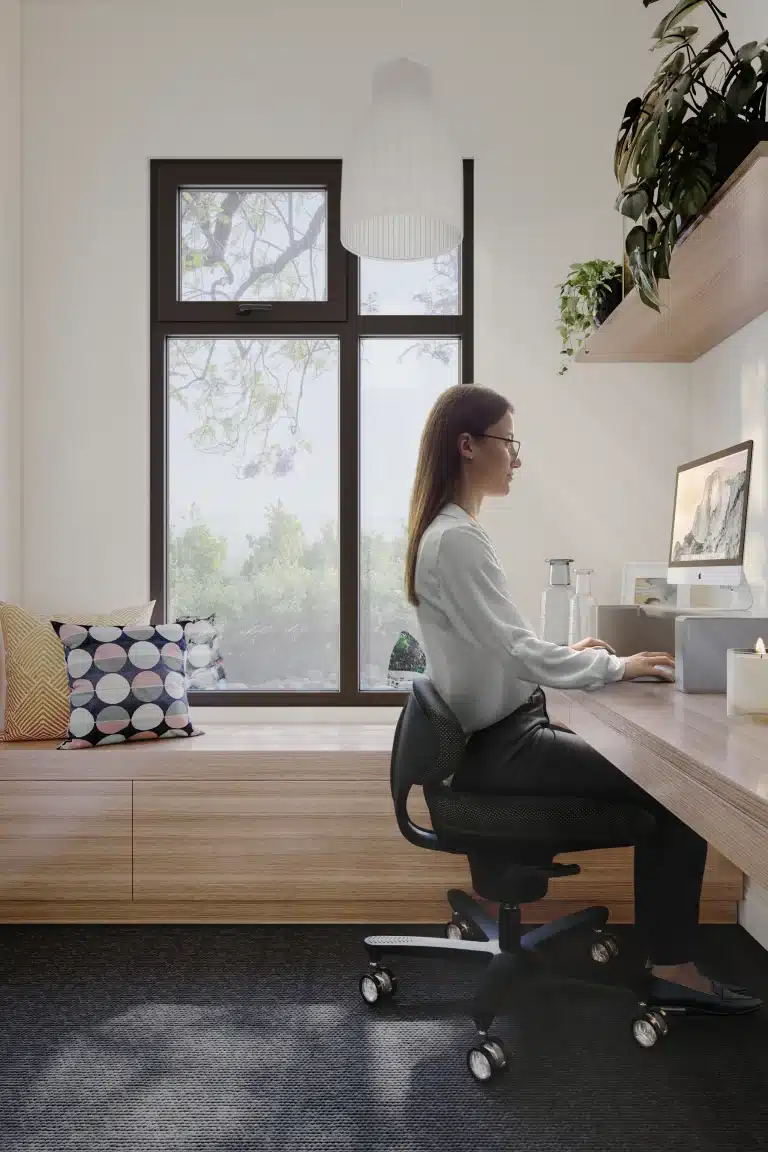
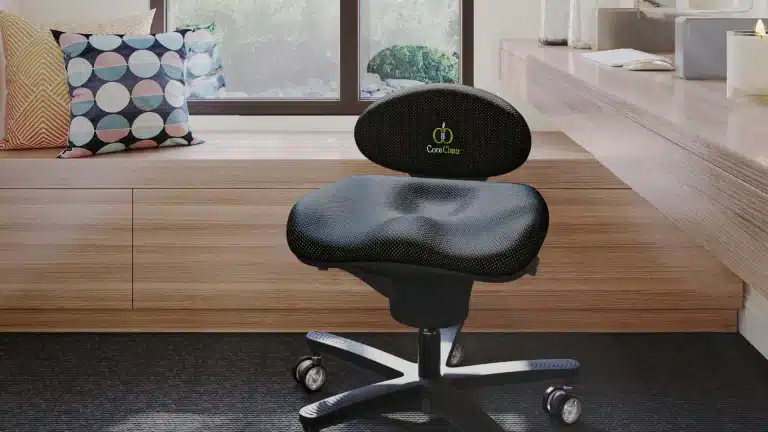
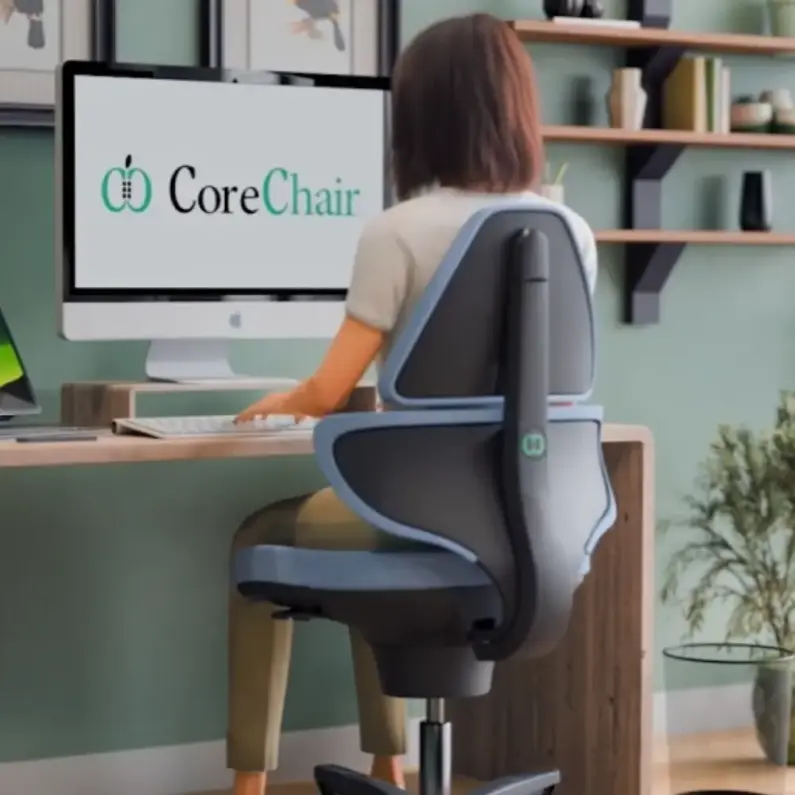
CoreChair is engineered with a sculpted seat and patented movement base that automatically positions the pelvis in neutral alignment. When the pelvis is neutral, the lumbar curve is maintained, the chest opens, and the head balances over the shoulders — the postural configuration that enables deep breathing and parasympathetic calm.
This alignment is not achieved through willpower. The seat establishes it structurally, so it persists through the fatigue and distraction that defeat conscious posture correction within minutes.
Research from the University of Waterloo confirmed that CoreChair significantly increased trunk muscle activation and postural stability compared to both conventional ergonomic chairs and stability balls. Engaged postural muscles maintain alignment; disengaged postural muscles allow it to collapse. CoreChair keeps the muscles engaged automatically.
Deep Breathing as a Default
By keeping the chest open and the diaphragm uncompressed, CoreChair supports full diaphragmatic breathing throughout the workday — without reminders, breathing exercises, or conscious effort. This continuous access to deep breathing keeps the parasympathetic nervous system active, cortisol suppressed, and the stress-posture cycle broken at its respiratory hinge point.
This is one of the most underappreciated benefits of active sitting: it makes calm the physiological default rather than something that has to be consciously sought.
Reducing Physical Pain
Cornell University research confirmed that CoreChair achieves significantly better pressure distribution than high-end conventional ergonomic chairs — protecting the tissue and joints that poor posture compresses over a workday. Less physical discomfort means less pain-driven cortisol, less stress reactivity, and a less activated sympathetic state throughout the day.
The CoreChair Elite offers enhanced adjustability for users who need precise configuration to address specific areas of tension or discomfort.
Circulation and Nervous System Recovery
The University of Guelph study measured improved blood flow and physiological regulation during active sitting on CoreChair. The Memorial University study found reduced perceived pain and improved circulation in the lower limbs. Improved circulation supports the nervous system’s ability to regulate itself — clearing the metabolic byproducts of stress and maintaining the physiological conditions for calm, focused work.
Davidson et al. (2025) demonstrated that active sitting produces measurable increases in metabolism and energy expenditure — the kind of low-level physical activity that research associates with reduced anxiety, improved mood, and better stress regulation. The body functions best when it moves, and CoreChair ensures it never completely stops.
Practical Steps to Break the Stress-Posture Loop
1. Replace the Environmental Trigger
The most effective intervention is changing the chair. The CoreChair Classic removes the structural conditions that sustain the posture-stress cycle — poor alignment, compressed breathing, static loading, and discomfort — automatically and for the entire workday.
2. Use Posture as a Stress Awareness Signal
Learn to use your body as a stress meter. When you notice your shoulders rising, your chest collapsing, or your jaw clenching, recognize it as a signal that your stress response is activated — and use it as a cue to breathe deeply and check your alignment. CoreChair makes this reset faster and more effective because the structural support is already in place.
3. Take Conscious Breathing Breaks
Three times daily, take two minutes to practice slow diaphragmatic breathing. Inhale for four seconds, expanding your belly. Exhale for six seconds. This directly activates the parasympathetic nervous system and interrupts the stress response. CoreChair’s posture makes this breathing pattern automatic — but brief, intentional practice accelerates the nervous system regulation benefit.
4. Address the Full Stress Picture
Active sitting addresses the physical dimension of the posture-stress cycle. But chronic stress also has psychological and environmental dimensions that require their own attention. Regular exercise, adequate sleep, meaningful social connection, and appropriate workload management all influence the stress load that the body has to process. CoreChair reduces the physical amplification of that load — complementing, not replacing, a holistic approach to stress management.
5. Create Movement Transitions
Every 60 minutes, stand and walk briefly. This resets the circulatory system, changes the postural demand, and provides the nervous system with the movement signals that promote emotional regulation and cognitive clarity. The overall connection between posture and your wellbeing is most powerful when sitting and movement work together.
Your Chair Is a Stress Management Tool
This bidirectional relationship is not incidental — it is structural and continuous. Every hour your chair allows your posture to collapse is an hour of amplified stress response, shallow breathing, elevated cortisol, and reduced resilience.
CoreChair’s research-backed active sitting design addresses the physical root of the stress-posture loop — maintaining the alignment, breathing, and muscular engagement that make calm the default rather than an achievement.
Explore the full CoreChair collection and discover what users report about working with a chair that supports your nervous system as well as your spine.
You cannot think your way out of a posture problem. But you can sit your way out of a stress loop.
Research and References on CoreChair Benefits
- Cornell University Pressure Mapping Study This study demonstrates better weight distribution and comfort on CoreChair compared to high-end ergonomic chairs, indicating that CoreChair provides superior support for long hours of sitting.
- University of Waterloo Posture & Muscle Recruitment Study The study shows that CoreChair significantly increases trunk stability, promotes movement, and activates core muscles, helping to improve posture and reduce the strain that comes with traditional seating.
- University of Guelph Physiological & Cognitive Measures Study This research highlights that CoreChair improves blood flow, enhances cognitive performance, and promotes more movement. These benefits contribute to better overall health and productivity.
- Memorial University Active Sitting Study The findings indicate that CoreChair reduces perceived back pain, improves sitting posture, and boosts lower limb blood flow, making it an effective option for individuals who sit for long periods.
- Mayo Clinic NEAT™ Certification CoreChair has received NEAT™ Certification for its ability to increase daily energy output, in line with NEAT™ (Non-Exercise Activity Thermogenesis) guidelines, showing that it helps people stay active throughout the day.
Additional Studies:
- Active Sitting Increases Energy Expenditure (Davidson et al., 2025) This study shows significant increases in metabolism and oxygen consumption during active sitting.
- Biomechanical Benefits of Active Sitting (Léger et al., 2023) Active chairs, like CoreChair, increase trunk movement, muscle activity, and postural variation, contributing to better overall biomechanics and reducing the risks of sedentary behavior.
- Active Sitting vs Traditional Sitting and Standing (Léger et al., 2022) Active sitting improves circulation, engages muscles more effectively, and boosts energy expenditure compared to both traditional sitting and standing postures.
- Physiological and Cognitive Outcomes with Multi-Axial Chair (Triglav et al., 2019) Active multi-axial chairs, such as CoreChair, improve circulation and reduce cognitive errors, highlighting the dual benefits of physical health and mental performance.
- Effects on Reading and Typing Productivity (Doroff et al., 2019) Research evaluating the effects of active sitting on cognitive performance and task productivity while seated on an active chair.