Every moment we sit, an invisible force works relentlessly against our bodies. Gravity – constant, unrelenting, and proportionate to our mass – compresses our spine, pools blood in our lower extremities, and gradually weakens the very muscles designed to support us. For the millions who spend 8-12 hours daily at their desks, this gravitational burden accumulates into what researchers now call “Gravity Deprivation Syndrome,” a condition sharing striking similarities with the physiological deterioration astronauts experience in space.
Yet there’s hope. Active sitting combined with optimal posture – as experienced through innovative seating solutions like CoreChair – offers a powerful countermeasure to gravity’s effects, transforming your chair from a health liability into a wellness tool that actively stimulates human physiology during prolonged sitting.
Understanding Gravity’s Toll on the Seated Body
The Gravitational Cascade
When we sit, gravity doesn’t simply pull us downward—it triggers a cascade of physiological changes that affect virtually every system in our body. Research comparing prolonged sitting to microgravity exposure reveals disturbing parallels: both conditions create what scientists term “unloading,” where reduced cardiovascular demands and lack of postural change signals lead to system-wide dysfunction.
The effects are profound and rapid:
Circulatory Compromise: Increased hydrostatic pressure in the legs causes blood to pool in the venous circulation. Without the muscle pump action that normally facilitates venous return, sitting becomes a gravitational trap. Studies demonstrate that just six hours of uninterrupted sitting significantly reduces blood flow and shear stress in both lower and upper limbs, impairing the vascular system’s ability to dilate properly.
Spinal Loading: The discs in our spine, filled with nerve endings that communicate position to our brain, experience increased loading when gravity pulls our body mass earthward while seated. Throughout each day, research shows measurably less water content in spinal discs by evening – evidence of relentless gravitational compression.
Metabolic Disruption: Prolonged sitting initiates metabolic changes characterized by insulin resistance, decreased fat oxidation, reduced protein synthesis, and muscle atrophy. The shift from slow-twitch to fast-twitch muscle fibers mirrors the muscular deterioration seen in astronauts, along with bone loss and ectopic fat storage.
Antigravity Muscle Atrophy: The more we sit, the more our antigravity muscles – those developed from infancy to help us stand, walk, and move – atrophy. We lose sensitivity to gravity’s force, creating a deteriorating relationship that manifests as poor posture, increased injury risk, and compromised alignment from head to feet.
The Passive Sitting Trap
Traditional office chairs, despite their cushioning and support features, actually contribute to this gravitational burden through what’s known as “passive sitting.” These chairs over – support the body, casting users into fixed positions that require minimal muscle engagement. While this might feel comfortable initially, it promotes unhealthy posture and gradually weakens muscles over time.
Without movement or muscle engagement, passive sitting leads to:
- Stiffness and chronic discomfort in the spine, neck, and shoulders
- Complete disengagement of core muscles in the abdomen, back, and pelvis
- Slumping and poor spinal alignment
- Reduced blood circulation throughout the body
- Cognitive decline and reduced mental performance
The CoreChair Solution: Active Sitting as Gravitational Countermeasure
Redefining the Relationship with Gravity
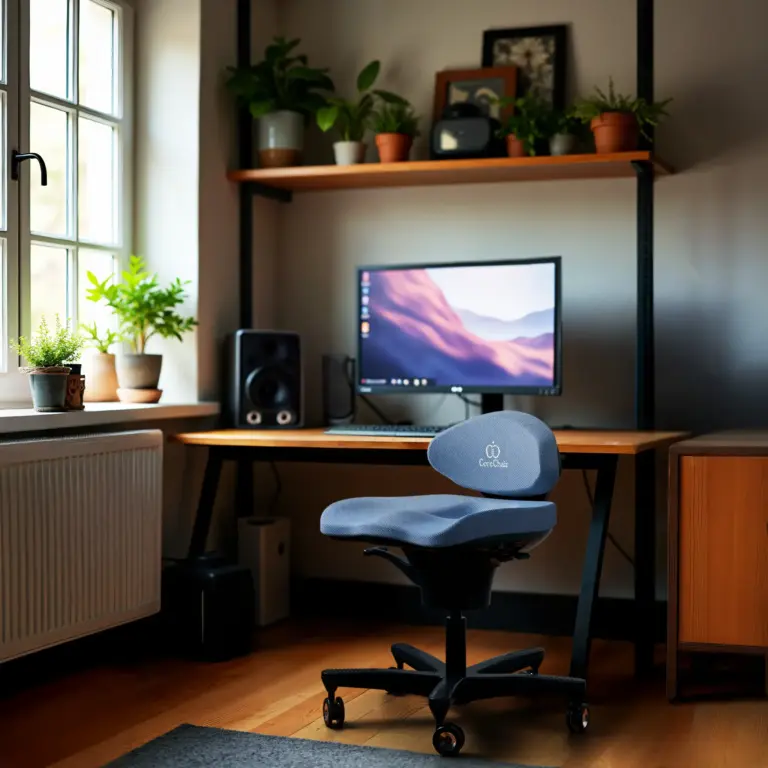
CoreChair represents a fundamental shift in seating philosophy. Rather than fighting gravity or surrendering to it, CoreChair harnesses principles of active sitting to work with gravitational forces, transforming them from a source of deterioration into a stimulus for physiological engagement.
The chair’s innovative design addresses gravity’s effects through three integrated mechanisms:
1. Pelvic Stability and Spinal Alignment
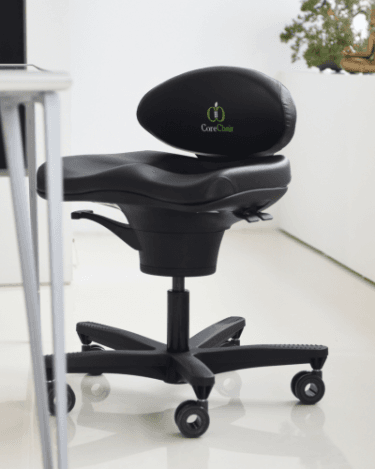
At the foundation of CoreChair’s effectiveness lies its pelvic support system. The sculpted memory foam pelvic support cushion molds to the top of your pelvis, re-aligning it to create the optimal foundation for a balanced spine. This upright vertical orientation of the pelvis encourages the spine to find its natural S-curve – the alignment that best distributes gravitational forces across the vertebral column.
Unlike traditional chairs where gravity pulls you into slouching, CoreChair’s design maintains your spine’s natural curvature, positioning your pelvis, spine, and head in naturally balanced alignment. This optimal posture doesn’t just look better—it fundamentally changes how gravitational forces impact your body, minimizing strain on supporting muscles and ligaments.
2. Dynamic Movement Platform
The chair’s pivoting seat moves and articulates up to 14 degrees in all directions, creating a dynamic platform that requires constant, subtle muscle engagement. This isn’t the exhausting balancing act of an exercise ball, which leads to fatigue and compensatory poor posture. Instead, CoreChair offers adjustable tension – a controllable degree of wobble that keeps core muscles gently engaged without overwhelming them.
This continuous low-intensity engagement serves multiple purposes in combating gravity:
- Core Muscle Activation: When you create movement through your hips, you instinctively engage muscles in your lower back, abdomen, and pelvis to maintain equilibrium. Research from the University of Waterloo confirms CoreChair is as effective as an exercise ball in activating core muscles, but without the fatigue factor.
- Joint Mobilization: The multi-directional movement improves joint mobility in the hips, pelvis, and spine—precisely the areas most affected by gravitational loading during sitting.
- Antigravity Muscle Maintenance: By requiring ongoing micro-movements to maintain balance and stability, active sitting prevents the antigravity muscle atrophy that typically accompanies prolonged sitting.
3. Enhanced Circulatory Dynamics
Perhaps most remarkably, CoreChair addresses one of sitting’s most insidious gravitational effects: circulatory compromise. The chair’s active sitting mechanism stimulates blood flow throughout the body, counteracting the venous pooling and reduced shear stress that normally occur during prolonged sitting.
Research conducted at the University of Guelph documented a significant reduction in calf circumference after four hours of CoreChair use – direct evidence of improved lower extremity blood flow. This enhanced circulation delivers multiple benefits:
- Increased blood flow to the brain, delivering oxygen and glucose for improved cognitive function, focus, and productivity
- Prevention of swollen ankles and legs that plague traditional seated workers
- Stimulation of endothelium lining in blood vessels through shear forces, maintaining vascular integrity
- Enhanced metabolic demand—studies show CoreChair can increase metabolic rate by 20%
The Physiological Symphony of Active Sitting
A Comprehensive Systemic Response
When you sit in a CoreChair, you’re not simply occupying a different chair—you’re initiating a comprehensive physiological response that combats virtually every negative effect of gravitational exposure during sitting.
Musculoskeletal Strengthening
The continuous core engagement required by active sitting builds strength over time in precisely the muscles gravity normally weakens. This isn’t intense exercise – it’s gentle, sustained activation that mirrors the way our antigravity muscles were designed to function. One chiropractor noted: “A great benefit of this chair is that your core actually gets stronger over time versus in other chairs where your core may decline over time.”
This strengthening creates a positive feedback loop: stronger core muscles provide better spinal support, which improves posture, which further optimizes how gravitational forces are distributed through your body.
Spinal Disc Health
Movement is essential for vertebral disc health. The diversity of motion encouraged by CoreChair stimulates blood flow to the spine, mobilizes joints, and helps hydrate vertebral discs – counteracting the compression and dehydration that gravity normally causes. For individuals with conditions like spondylolisthesis, this can be transformative, providing the support needed to manage the condition while maintaining spine alignment and preventing further misalignment.
Metabolic Activation
Unlike passive sitting, which triggers metabolic disruption, active sitting maintains metabolic function. The increased movement burns calories—helping manage weight and mood while providing energy. The enhanced blood flow stimulates delivery of oxygen and glucose throughout the body, supporting everything from wound healing to immune function.
Neurological Benefits
The constant positional feedback your body receives during active sitting keeps your nervous system engaged. The micro-adjustments required to maintain balance preserve the sensitivity of balance and coordination systems that gravity deprivation normally diminishes. Meanwhile, increased cerebral blood flow enhances cognitive power, improving your ability to learn, remember, and solve problems.
Long-Duration Comfort Through Physiological Harmony
What makes CoreChair exceptional for long-duration sitting isn’t just its immediate comfort – it’s the way it maintains comfort by keeping your body in physiological harmony with gravitational forces. Users consistently report that unlike traditional chairs where discomfort builds throughout the day, CoreChair becomes more comfortable as your body adapts to active sitting.
This occurs because:
- Continuous circulation prevents the buildup of metabolic waste that causes muscle fatigue and pain
- Regular micro-movements prevent the joint stiffness that makes prolonged sitting progressively uncomfortable
- Maintained core engagement prevents the progressive slouching that increases gravitational strain on the spine
- The sculpted seat design distributes pressure evenly, preventing the pressure point discomfort that develops in conventional chairs
Practical Implementation: Maximizing the Benefits
The Adaptation Period
Transitioning to active sitting requires an adjustment period as your body relearns to actively engage with gravity rather than passively surrender to it. Most users report an adaptation phase of several days to two weeks, during which they may experience mild muscle fatigue – evidence that previously dormant muscles are being reactivated.
For optimal results:
- Start gradually: Begin with 2-4 hours daily in the CoreChair, increasing duration as your core strength builds
- Adjust tension appropriately: Use the chair’s tension lever to find your optimal level – enough movement to engage muscles but not so much that you fatigue
- Maintain awareness: The chair encourages good posture, but remain conscious of your positioning, using the 90-degree backrest as a guide for your lower back
- Incorporate movement breaks: Even with active sitting, periodic standing and walking further optimizes your physiological response to gravity
Postural Cues and Positioning
CoreChair’s design provides constant postural feedback. The small backrest angled at 90 degrees serves as a guide for your lower back to stay upright, while the molded contours of the seat keep your pelvis positioned correctly against the backrest. With your upper back uninhibited by a tall backrest, you’ll naturally find yourself stretching backward and engaging your entire back and shoulder blades.
For optimal seated posture:
- Keep upper arms loose with elbows at or just above 90 degrees
- Position hands on your work surface rather than relying on armrests
- Allow the chair’s natural wobble to remind you to engage your core
- Perform shoulder rolls and back stretches periodically—the chair’s design facilitates these movements
Long-Term Wellness Integration
The true power of active sitting emerges over weeks and months of consistent use. Users report:
- Progressive reduction in back pain and discomfort
- Increased energy levels throughout the workday
- Improved posture even when not in the chair
- Enhanced core strength noticeable in other activities
- Better sleep quality due to reduced pain and improved circulation
- Greater overall sense of wellbeing and vitality
Conclusion: A New Paradigm for Seated Work
Gravity is relentless – it acts on our bodies 24 hours a day, seven days a week, and over time, it will take its toll. But we’re not powerless against this fundamental force of nature. By understanding how gravity affects our seated bodies and implementing active sitting strategies, we can transform our relationship with this constant companion.
CoreChair represents more than ergonomic innovation – it’s a paradigm shift in how we approach prolonged sitting. By stabilizing the pelvis, encouraging continuous gentle movement, and promoting optimal spinal alignment, it transforms your chair from a tool of gravitational surrender into an instrument of physiological engagement.
The result is remarkable: comfort that persists through long durations, not despite gravity, but by working harmoniously with it. Your core strengthens rather than atrophies. Your circulation improves rather than stagnates. Your spine maintains its natural curves rather than collapsing under gravitational load. Your mind stays alert and focused rather than foggy and fatigued.
In the battle between gravity and human physiology, active sitting doesn’t eliminate the opponent – it changes the rules of engagement entirely. And for the millions who must sit for extended periods, this change makes all the difference between gradual deterioration and sustained vitality.
The question isn’t whether gravity will affect you during prolonged sitting – it will. The question is whether you’ll passively accept its toll or actively combat its effects through optimal posture and dynamic movement. With CoreChair, the choice is clear, the mechanism is proven, and the benefits are profound.
Note: While CoreChair offers significant benefits for many users, individuals with specific medical conditions should consult healthcare providers before making major changes to their seating arrangements. The information in this article is for educational purposes and does not constitute medical advice.