If you spend most of your workday in a chair, you’ve probably wondered: can sitting all day cause weight gain? It’s a reasonable concern. Many people notice changes in their body composition after starting desk jobs, and the question of whether sitting itself is to blame has become a significant area of scientific inquiry.
The short answer is nuanced. Sitting doesn’t directly deposit fat on your body, but the downstream effects of prolonged, sedentary sitting on your metabolism, energy expenditure, and hormonal regulation create conditions that make weight gain far more likely. Understanding why – and what you can do about it – starts with the science of how your body processes energy when you’re largely immobile.
What Actually Happens to Your Body When You Sit for Hours
To understand the relationship between sitting and metabolism, you need to understand what your body stops doing the moment you become sedentary.
Your Metabolic Rate Drops Sharply
When you sit still, the large muscle groups in your legs, glutes, and core go largely inactive. These are some of the most metabolically demanding tissues in your body. When they’re disengaged, your resting metabolic rate – the number of calories you burn at baseline – falls significantly.
Research has documented how extended sedentary bouts suppress lipoprotein lipase (LPL) activity, an enzyme critical to fat metabolism. When LPL activity drops, your body becomes less efficient at clearing fat and triglycerides from your bloodstream. The fat doesn’t go away; it stays in circulation or gets stored.
Blood Glucose and Insulin Sensitivity Suffer
Sustained sitting also impairs your body’s ability to manage blood glucose. Without muscle contractions pulling glucose out of circulation, blood sugar levels rise, prompting the pancreas to release more insulin. Over time, repeated cycles of elevated insulin in response to sedentary periods can contribute to insulin resistance – a metabolic state closely associated with fat accumulation, particularly around the abdomen.
This is not a theoretical risk. Multiple peer-reviewed studies have linked high volumes of sitting time with increased markers of metabolic syndrome, independent of other lifestyle factors.
NEAT Collapses – and That’s the Real Problem
Here’s where the direct link between sitting all day and weight gain becomes clearest. NEAT – Non-Exercise Activity Thermogenesis – refers to all the calories you burn through movement that isn’t formal exercise. This includes walking to the printer, shifting in your seat, fidgeting, standing up to reach for something, and dozens of other micro-movements that happen naturally when your body isn’t locked into a fixed posture.
Research from the Mayo Clinic has shown that NEAT can account for hundreds of calories per day in active individuals – and that sedentary individuals burn dramatically fewer calories through NEAT than their active counterparts. The difference can be as much as 300–400 calories per day, which adds up to meaningful changes in body weight over weeks and months.
When you sit in a conventional chair for eight or more hours, NEAT all but disappears. Your body is held in a position, your muscles aren’t engaging, and the small spontaneous movements that would otherwise occur are suppressed by the chair’s structure.

Does Sitting in the Office All Day Make You Fat? The Energy Equation
So does sitting in the office all day make you fat? Not in isolation – but it creates a profound energy imbalance that makes fat accumulation increasingly likely.
Weight gain, at its most fundamental, results from consuming more calories than you expend. Prolonged sedentary sitting attacks both sides of that equation. On the expenditure side, it reduces your metabolic rate, shuts down NEAT, and impairs the muscle activity that burns calories throughout the day. On the intake side, research has also shown that sedentary behaviour is associated with increased appetite-stimulating hormones and a tendency toward more frequent snacking – likely because sitting in front of screens increases exposure to food cues and reduces mindful awareness of hunger and satiety signals.
The compounding effect is significant. A person who spends eight hours sitting at a desk, commutes by car, and then relaxes on a couch in the evening may be spending 70–80% of their waking hours in sedentary postures. Over months and years, the cumulative metabolic suppression becomes a powerful driver of body composition changes.
It’s also worth noting that exercise alone doesn’t fully offset the damage. Studies have found that even people who meet recommended exercise guidelines but spend the rest of their day sitting still show elevated metabolic risk markers compared to those who intersperse movement throughout their day. This is sometimes called the “active couch potato” paradox – and it underscores why how you sit matters, not just whether you exercise.
Why Conventional Chairs Make This Worse
Most office chairs are designed to minimise movement. Deep seat pans, rigid lumbar supports, and high backrests are all intended to keep your body still and supported. The problem is that the body was never designed to be held perfectly still for eight hours.
When a chair eliminates all postural challenges, your core muscles have no reason to engage. Your hips are fixed. Your pelvis is tilted posteriorly. Your spine is held in a curve that, over time, stiffens and compresses the intervertebral discs. The chair does all the work, and your musculature does none.
This is the design problem that active sitting addresses directly.
How Active Sitting Counters the Metabolic Effects of Sedentary Work
Active sitting is an approach to seating that keeps the body in gentle, continuous motion rather than locking it into a fixed position. Instead of a seat that holds you still, an active chair uses a tilting, pivoting seat platform that requires the core muscles to engage continuously to maintain balance and upright posture.
This matters enormously in the context of sitting and metabolism.
Continuous Micro-Movement Preserves NEAT
When your seat platform moves with you – tilting forward, backward, and side to side as you shift your weight and adjust your posture – your body is in a state of continuous low-level muscular activity. You’re not exercising in any meaningful sense, but you’re producing a steady stream of micro-movements that collectively contribute to NEAT throughout the day.
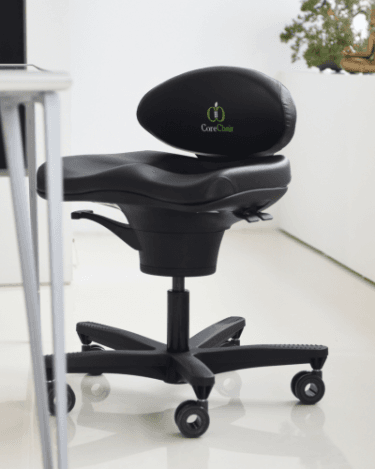
CoreChair’s active seat design is built specifically around this principle. The contoured seat allowing up to 14 degrees of tilt in all directions – allow the pelvis to move freely, which keeps the core engaged, the hip flexors from shortening, and the postural muscles active throughout the workday.
Core Engagement Changes Your Caloric Baseline
The Mayo Clinic NEAT™ certification – which CoreChair has earned – validates that movement-promoting seating can meaningfully increase energy expenditure compared to conventional chairs. While this doesn’t replace exercise, it represents a genuine improvement over sedentary sitting – particularly across the cumulative hours of a full workday.
Davidson et al. (2025) showed that active sitting produces significant increases in metabolism and oxygen consumption during standard office tasks – confirming that the movement CoreChair enables is not cosmetic but functionally significant.
The Mayo Clinic and Arizona State University study measured caloric burn during typical office tasks on CoreChair versus a standard office chair, finding a 20% increase in metabolic demand – a direct, quantified answer to the question of whether your chair can affect how many calories you burn while you work.
Léger et al. (2022) demonstrated that active sitting improves circulation, muscle engagement, and energy expenditure compared to both standard chairs and standing desks – placing active sitting ahead of the sit-stand desk in terms of continuous metabolic engagement during seated work.

CoreChair’s Research Foundation
CoreChair’s approach isn’t based on marketing claims. It’s grounded in peer-reviewed research conducted at multiple independent institutions.
A pressure mapping study at Cornell University under Dr. Alan Hedge confirmed that CoreChair’s seat design significantly reduces ischial pressure compared to conventional chairs – a finding that directly relates to circulation. Poor circulation during sitting is associated with impaired nutrient and oxygen delivery to tissues, which matters both for comfort and for long-term metabolic function.
The University of Waterloo research led by Dr. Jack Callaghan examined spinal loading and posture, while the Memorial University study and the University of Guelph research conducted by Dr. Leah Bent further explored the chair’s ergonomic effects on posture and muscular engagement. The body of evidence is consistent: active sitting on CoreChair engages the body differently – and more productively – than passive sitting on a conventional chair.
Léger et al. (2023) found that active chairs significantly increase trunk movement, muscle activation, and postural variation – the three physiological variables most strongly associated with reduced metabolic suppression from prolonged sitting.
Triglav et al. (2019) showed that multi-axial active chairs improve circulation and cognitive performance compared to standard office chairs – connecting the metabolic and cognitive dimensions of seating quality.
Practical Guidance: What to Do If You Sit All Day
Understanding that prolonged sedentary sitting suppresses your metabolism and undermines NEAT is the first step. Here’s how to apply that knowledge practically.
1. Audit Your Sitting Hours
Most people underestimate how much time they spend sitting. Track it for a week. If you’re regularly exceeding six hours of sitting per day, that’s a significant metabolic burden regardless of your exercise habits. The connection between posture, health, and long-term wellbeing starts with awareness of how much time you spend in sedentary positions.
2. Prioritise Movement Quality Over Duration
Standing desks are popular, but standing still has many of the same metabolic drawbacks as sitting still – without the comfort. The goal is movement, not just changing position. Micro-movements throughout the day are more metabolically significant than occasional position changes.
3. Choose Seating That Works With Your Body
Your chair is the environment your body lives in for a third of your waking hours. A CoreChair Classic ($995, 60-day guarantee, 8-year warranty) or CoreChair Elite ($1,195, with Clever Spine dynamic thoracic support) replaces passive, sedentary sitting with an active, movement-promoting alternative – keeping your core engaged, your posture dynamic, and your NEAT from flatling during the workday. Review CoreChair’s active sitting benefits and what users report about changes in comfort and energy across real working days.
4. Pair Active Sitting With Intentional Movement Breaks
Even with an active chair, taking brief walks every 60–90 minutes amplifies the metabolic benefits. Active sitting is a foundation, not a ceiling. The combination of continuous micro-movement during seated work and regular full-body movement breaks addresses metabolic suppression more comprehensively than either intervention alone.
5. Understand the Long Game
The metabolic consequences of chronic sedentary sitting accumulate over years, not days. Changing your seated environment now has compounding benefits over time – for body composition, for spinal health, for circulation, and for long-term metabolic function. Explore the full CoreChair research base and the complete product collection to understand the science behind the seating choice.
The Honest Answer to “Does Sitting Down Make You Fat?”
Does sitting down make you fat? Not through any single mechanism, and not automatically – but sustained, sedentary sitting creates metabolic conditions that make fat accumulation significantly more likely over time. It suppresses the enzymes responsible for fat metabolism, impairs insulin sensitivity, collapses NEAT, and reduces the muscle engagement that keeps your metabolic rate healthy.
The solution isn’t to stop sitting. For most knowledge workers, that’s not realistic. The solution is to sit differently – in a way that keeps your body engaged, your posture dynamic, and your metabolism from shutting down for eight hours a day.
Active sitting doesn’t replace exercise, and it won’t undo a caloric surplus. But it does meaningfully change what your body is doing while you work – and across thousands of hours of seated work per year, that difference adds up.
Your chair is either working against your metabolism or working with it. CoreChair is designed to work with it.
Research and References
- Cornell University Pressure Mapping Study – Superior pressure distribution on CoreChair vs high-end conventional ergonomic chairs.
- University of Waterloo Posture & Muscle Recruitment Study – CoreChair increased trunk stability and core muscle activation.
- Mayo Clinic & Arizona State University Energy Expenditure Study – CoreChair showed higher energy expenditure compared to standard office chair.
- Mayo Clinic NEAT™ Certification – Measurable increases in daily energy output under NEAT™ guidelines.
- Memorial University Active Sitting Study – Reduced perceived back pain and improved lower limb blood flow.
- University of Guelph Physiological & Cognitive Measures Study – Improved blood flow and skin sensitivity on CoreChair.
- Active Sitting Increases Energy Expenditure (Davidson et al., 2025) – Significant increases in metabolism and oxygen consumption during active sitting.
- Biomechanical Benefits of Active Sitting (Léger et al., 2023) – Active chairs increase trunk movement, muscle activity, and postural variation.
- Active Sitting vs Traditional Sitting and Standing (Léger et al., 2022) – Active sitting improves circulation, muscle engagement, and energy expenditure.
- Physiological and Cognitive Outcomes with Multi-Axial Chair (Triglav et al., 2019) – Active multi-axial chairs improve circulation and reduce cognitive errors.
- Effects on Reading and Typing Productivity (Doroff et al., 2019) – Active sitting supports cognitive performance and task productivity.