How to understand which chair is the best for posture correction?
Most people are aware that the discomfort that they experience when sitting, especially for long hours, is the result of poor sitting posture.
The challenge is to best understand what is the best chair to correct posture and to get there, we need to understand what is the correct sitting posture.
Traditional ergonomic office chairs used to encourage that a person sit with a 90 degree hip flexion, 90 degree bend at their knees and 90 degree ankle position when their feet are flat on the floor.
Over time it became evident that attempting to sit in this position and fight the forces of gravity that want to push us down, was problematic. When we attempt to sit with a posture like this, it doesn’t accommodate the natural curves of our spine and pelvis and gravity has fun pressing these joints into collapsed positions.
Suggestion of the correct posture while sitting on a chair
Recognizing the effects of this compromised sitting posture, designers and well intentioned practitioners of ergonomics, proposed that rather than changing the design of the current traditional chair design, they would recommend using it in a different way.
The relatively new theory from traditional ergonomists is to instruct users of this chair design, to adjust their back support to a slightly reclined position. The outcome, they believe, is to apply more of the gravitational forces along the entire spine to avoid the collapse that was believed to be responsible for forward flexion of the spine which might compress both intervertebral discs and nerve roots leaving these spaces within the spine.
In addition, with the seat remaining fairly level, the users hips were allowed to present a more open hip angle, which would theoretically reduce pressure on the internal organs.
A couple of negative outcomes come with this position.
First, the user now must sit further from their work surface t maintain this recline of the back support. When assuming this position, the user must then reach to their work surface, key board and mouse, which results in the unnecessary engagement of the upper back, shoulder and neck muscles to sustain. With this occurring a whole new set of musculoskeletal disorders are presented.
Second, when attempting to maintain this position, with a reclined back support and a relatively flat seat, there is a tendency to slide on the sit surface, causing a position of sacral sitting where the pelvis is tilted rearward. With the pelvis tilted like this, the lumbar spine in particular flattens and the result is increased forces between the vertebrae. Displacement of the gelatinous disc and pressure on the nerve roots.
The symptomatic reaction was to introduce a slanted foot support to accommodate this reclined position and provide some resistance to the tendency to slide. With any muscular resistance through the legs to sustain this position, relatively isometric forces are now introduced that bring on potential new problems.
An alternative correct sitting posture
An alternative correct sitting posture is to focus on the pelvis such that it maintains an upright vertical position and allows the spine to find natural extension and balance similar to what we experience when standing.
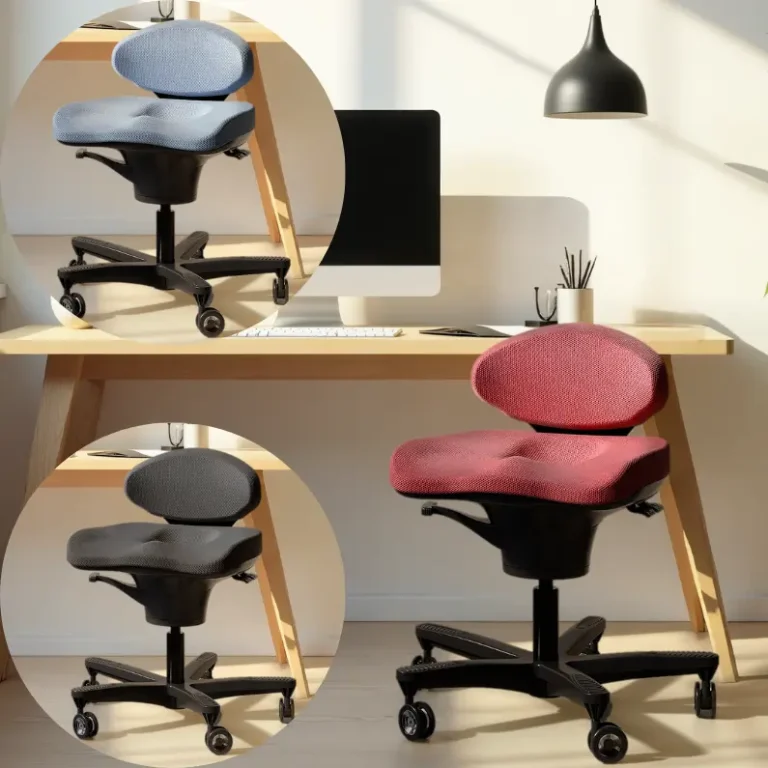
CoreChair designed a human interface to attain this correct sitting posture that focuses on the neutral but embraced pelvis. It accomplished this in several ways.
First, the seat is sculpted to not only evenly distribute forces on the sit surface but also diminish the opportunity for the sit bones to slide on the sit surface to prevent sacral sitting.
Second, CoreChair also introduces a short back support that applies force on the top of the back of the pelvis, maintaining this vertical position of the pelvis.
Together these to design features embrace the pelvis to keep it vertical, addressing this much like a pair of Birkenstock shoes or orthotics, embrace the prominent bony structures of the foot.
The result is a more upright extended spine beginning in the lumbar region and ascending upward to attain the natural shapes of the human spine.
Third, by allowing the sit surface to tilt down to the front and reducing the tendency for the sit bones to slide with this position, the hip angle is allowed to stay more open, reducing pressure on the internal organs but also biomechanically maintaining a more vertical pelvic position.
The overall result is a correct sitting position where the foundation or pelvis is supported and the spine is allowed to move into a more natural extended spine that resists the effects of gravity by allowing this force to press downward through the natural structural shape of the vertebral column.
The users head is allowed to find a natural balanced position with the ears comfortably positioned over the users shoulders.
The user is able to move forward toward their work surface and can allow their arms to naturally hang at their sides reducing, the strain on the upper back, shoulders and neck.
With the spine less supported but balanced, the spine is allowed to assume more natural movement of flexion, extension and rotation which is otherwise inhibited by the reclined and overly supported high back of traditional ergonomic chairs.
CoreChair further enhances their design for correct sitting posture by introducing movement of the entire chair, allowing engagement of core stabilizing muscles, stimulation of nerve roots, enhanced circulation of blood and lymphatic fluids as well as vestibular stimulation.
For persons who have spent their career sitting in traditional chair designs and now searching for the correct sitting posture, this CoreChair design may seem a bit uncomfortable at first. Indeed it is much like beginning a new exercise routine where the previously dormant and likely weaker core stabilizing muscles are now challenged. This discomfort, while not common to all, is a good sign that a healthy dynamic activity is taking place and this correct sitting posture will have a carry over effect to their other activities of daily living much like an effective exercise routine.
When you begin your search for the correct body position, be aware of your body, how it is designed and how it is best maintained.
CoreChair– your simple solution to back pain.
Similar to an orthotic device that is designed to embrace and support various boney structures and joints within our bodies, CoreChair optimizes pelvic support with a complimentary sculpted seat and pelvic support cushion. In harmony, these cushions embrace your pelvis to encourage an upright neutral pelvic orientation. Like building a house, we need to start with a good foundation.
The outcome is a stable base that allows balance in our spine as well as the ability of our spine to work as designed with ease of natural movement through flexion, extension and rotation.
A healthy spine also requires a diversity of movement which involves stimulating blood flow, mobilizing the joints, strengthening core muscles and hydrating the vertebral discs. Often when we experience back pain our tendency is to rest up and stop strenuous activity. While this may be recommended in the short term, long term it may not be helpful. Movement and specific back exercises are needed to help alleviate and remedy back pain. Moving on a CoreChair provides an excellent opportunity to gradually work the back and core in a controlled manner to help avoid stiffness, strengthen and alleviate pain.
A study completed by Memorial University concluded that participants sitting in the CoreChair adopted a more upright posture, experienced less back pain and stiffness and had enhanced blood flow when compared to sitting in a traditional office chair.

Reduced Back Pain
Pelvic support provides the foundation for a balanced healthy spine to prevent slumping, optimize posture, and reduce back pain and discomfort.

Core Strength
Movement is the key to maintaining core strength and more movement will definitely build strength. One absolute is that if you don’t use it you will lose it.
Extraordinary comfort meets incredible pelvic support.
Proper distribution of our weight when sitting is a critical factor in chair selection as it translates into seating comfort. Poorly designed chairs can result in uncomfortable pressure points and restriction of circulation. The seat of the CoreChair is aggressively sculpted to embrace your sit bones and provide even weight distribution allowing your circulation to flow freely, so you can focus on your work, not your discomfort.
Graduate students from Cornell University (with guidance from Dr. Alan Hedge), investigated sitting pressure on CoreChair compared to a high-end ergonomic office chair and discovered that CoreChair has more evenly dispersed weight thereby significantly lowering pressure points. This means significantly better comfort for you.
Sculpted Seat
Sculpted seat harmonizes with pelvic stabilizer to relieve pressure points, prevents sliding, and provide added comfort.

Pelvic Support
Our seat cushion works in conjunction with the pelvic support to stabilize the pelvis, optimize sitting posture, and reduce back pain.
Boosting brain power through movement.
Being physically active not only helps us avoid negative outcomes such as chronic disease and obesity, but also helps to boost our brainpower! Cognition, how we understand and interact in the world, related to the brain-based skills needed to learn, remember and solve problems. Physical activity, whether exercise in the gym or incidental movement on your CoreChair, aids our cognitive power by stimulating blood flow to the brain, delivering oxygen and glucose to make us better able to work on tasks both simplistic and complex. Introduce movement into your workday and experience the benefits of improved focus, increased productivity, and more brainpower!
Dr. Leah Bent conducted a four-hour investigation at the University of Guelph and discovered there was a significant reduction in calf circumference indicative of improved lower extremity blood flow and a significant reduction of errors commissioned utilizing SART (Sustained Attention to Response Task) suggesting enhanced cognitive function with blood flow.

Blood Flow
Movement stimulates your lymphatic system and blood flow to keep your vital systems working well.

Brain Power
Increased blood flow to the brain keeps you alert and creative, making you happier and more productive in the workplace.
IMPROVING YOUR HEALTH ONE MOVE AT A TIME.
There’s a distinct difference between exercise and physical activity. Exercise is a subcategory of physical activity and is planned, structured, repetitive and purposeful with a fitness objective. Physical activity includes exercise in addition to other activities that involve movement including pacing, household chores and other recreational activities.
CoreChair is proud to be NEAT™ Certified (NEAT™ stands for the science of Non Exercise Activity Thermogenesis, developed by Mayo Clinic). We now know that activity, all activity, is good for our health.

Increased Caloric Burn
Movement burns calories and helps manage our weight and mood, which bolsters our energy! CoreChair users can expect an increased metabolic demand of 20%!

Increased Circulation
Swollen ankles? Movement stimulates your circulation. Not just to make your heart pump but also assists your vascular return.