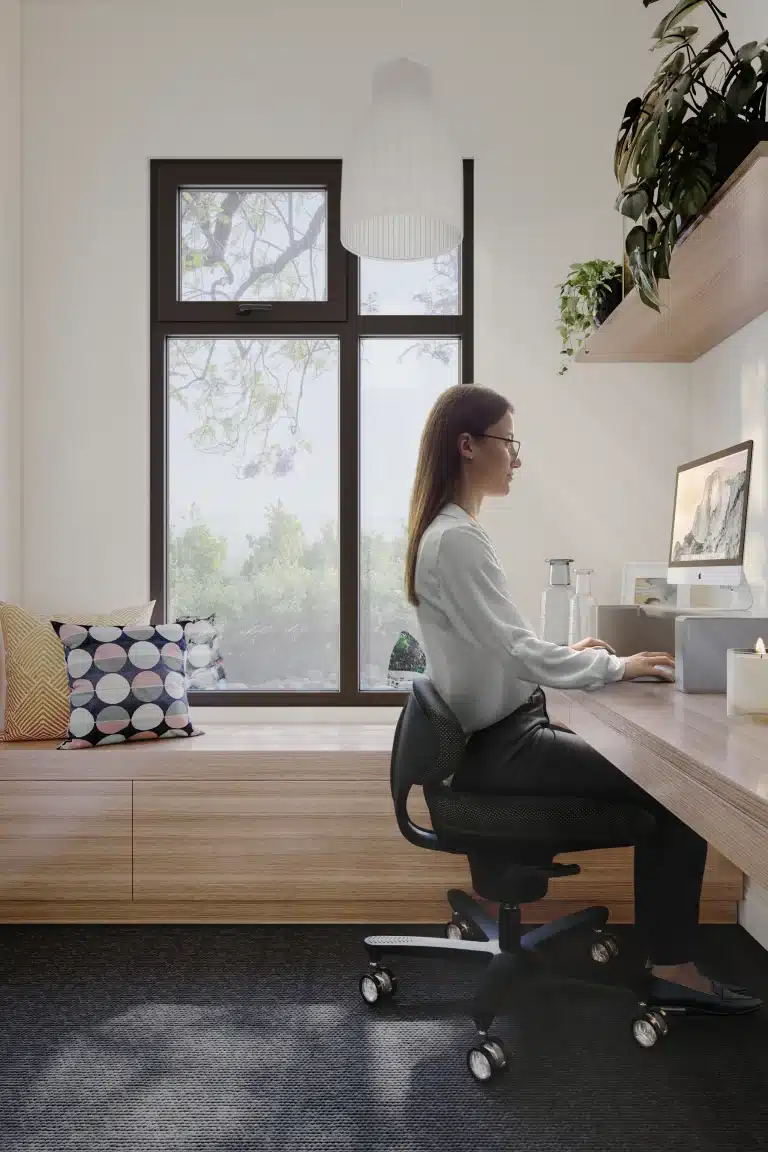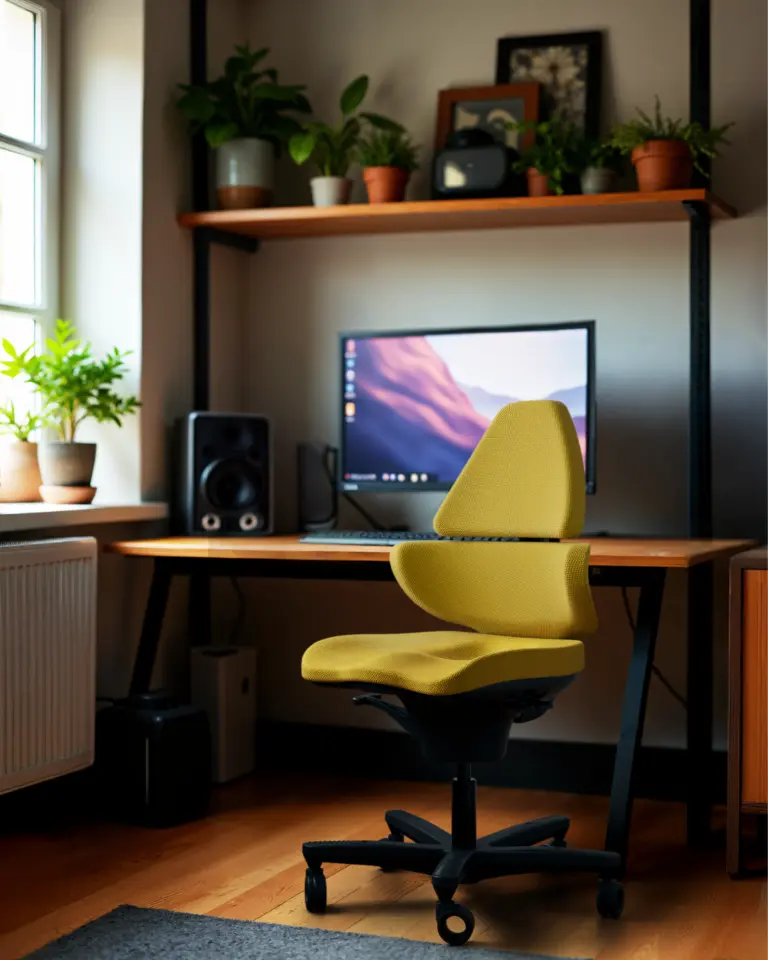
If you’ve been diagnosed with a herniated or slipped disc, you’ve probably already received the standard advice: rest, physiotherapy, perhaps anti-inflammatories. What you may not have been told is that the chair you spend eight hours a day in -designed by a kinesiologist and seating specialist working with healthcare professionals -can be part of your recovery environment. What you may not have been told is that the chair you spend eight hours a day in could be actively prolonging your injury -not just failing to help, but making the underlying pathology measurably worse.
This isn’t a minor distinction. Understanding why certain chairs for slipped discs are harmful, what the biomechanics of disc injury actually require, and what to look for when choosing a chair for slipped discs is one of the most practically important things you can do for your recovery and long-term spinal health.
What a Slipped Disc Actually Is and Why It Matters for Seating
The term “slipped disc” is colloquial, but the underlying condition is well-defined in clinical literature. An intervertebral disc consists of two components: the nucleus pulposus, a gelatinous core under pressure, and the annulus fibrosus, the tough ring of fibrocartilage surrounding it. A herniation occurs when repeated or sustained mechanical stress causes the nucleus to push through a weakened or torn region of the annulus -a process that can take years of cumulative loading before it becomes symptomatic.
The most commonly affected levels are L4–L5 and L5–S1, the two lowest segments of the lumbar spine. These segments bear the greatest mechanical load during sitting and forward flexion and are consequently the most vulnerable to disc pathology.
What matters enormously for seating is this: the disc has no direct blood supply. It receives its nutrients -oxygen, glucose, and water -through a process of fluid exchange driven by intermittent compressive loading and decompression. When you sit motionless in a fixed position for hours, this fluid exchange slows dramatically. The disc becomes nutritionally deprived and mechanically stressed simultaneously. This is not a backdrop condition. It is an active process of ongoing harm that the right -or wrong -chair will either mitigate or accelerate.
Why Conventional Chairs Worsen Disc Pathology
Most office chairs are not biomechanically neutral. They are designed around a geometry -seat pan angle, backrest height, lumbar support position -that tends to push the pelvis into a posterior tilt. In practical terms, this means your pelvis rocks backward, your lumbar curve flattens or reverses, and the front of your intervertebral discs closes while the back opens.
This position is precisely what disc mechanics cannot tolerate. When the lumbar spine is in flexion -which is what a posteriorly tilted pelvis creates -the posterior aspect of the annulus fibrosus is placed under maximum tension. This is the region already compromised in most lumbar herniations. Sustained flexion-biased seating does not give the annulus time to recover. It holds it in the position of greatest vulnerability for hours at a stretch.
Kuster et al. (2018) documented the relationship between seating posture and intradiscal pressure, finding that forward-flexed, posteriorly tilted postures significantly increase mechanical load on the posterior disc structures. For someone managing a herniation at L4–L5 or L5–S1, this kind of sustained loading is not simply uncomfortable -it is pathologically counterproductive.
The problem compounds over time. Sitting in posterior pelvic tilt for eight hours a day does not just affect the disc during that period. It trains the surrounding musculature -particularly the hip flexors and lumbar erectors -into chronic shortening patterns that persist even when you’re standing or walking, perpetuating a postural baseline that keeps the lumbar spine in a mechanically disadvantaged position throughout the day.
The Reclining Chair Misconception
Some recommendations for an office chair for slipped discs suggest reclining chairs on the basis that reclining reduces intradiscal pressure. This is true -measured intradiscal pressure does decrease when you recline to approximately 135 degrees compared to sitting upright. However, this benefit needs to be examined carefully.
Reclining is not a working position. Sustained recline during active desk work is impractical, promotes disengagement of the core and postural muscles, and typically results in the user periodically returning to an upright position -often with the same posteriorly tilted, flexion-biased posture they started with. Reclining also doesn’t address disc nutrition, because it doesn’t promote the fluid exchange movement that the disc depends on. It is a pressure-reduction strategy, not a movement strategy.
The disc’s recovery requires more than pressure reduction. It requires movement.
Extension-Bias vs Flexion-Bias: The Critical Distinction
Clinical management of lumbar disc herniations has for decades included attention to directional preference -the concept that certain movements or sustained positions either centralise pain (relieve it) or peripheralise it (worsen it). For the majority of posterior and posterolateral herniations at L4–L5 and L5–S1, extension-biased postures and movements are beneficial, while flexion-biased postures and movements worsen symptoms.
Extension-bias in seating means maintaining or restoring the natural lumbar lordosis -the inward curve of the lower back -through an anterior (forward) pelvic tilt. When the pelvis tilts slightly forward, it restores the lumbar curve, reduces tension on the posterior annulus, allows the nucleus to migrate anteriorly away from compressed nerve roots, and places the disc in a mechanically favourable position.
Flexion-bias is the opposite. A posteriorly tilted pelvis, a flattened or reversed lumbar curve, and a slumped thoracic posture all constitute flexion bias. Most conventional office chairs, through the geometry of their seat pan and backrest angle, guide users toward exactly this position.
The best office chair for slipped discs is not one with the thickest lumbar pad or the highest backrest. It is one that actively supports anterior pelvic tilt, maintains the lumbar lordosis without rigidly fixing the spine, and -critically -allows and encourages gentle movement throughout the day to sustain disc nutrition.
What the Disc Needs That Conventional Chairs Cannot Provide
Recognising that the intervertebral disc relies entirely on fluid exchange for nutrition changes the fundamental question you should ask about seating. It is not: does this chair reduce pressure when I sit still? It is: does this chair keep me moving enough to nourish my discs throughout the working day?
The fluid exchange mechanism in avascular discs depends on compressive loading and unloading cycling through movement. When the spine is held completely still -as it is in most heavily supported conventional chairs -this cycling does not occur. Metabolic waste products accumulate within the disc, nutrient delivery slows, and the disc’s capacity for self-repair diminishes.
Léger et al. (2022) found that active sitting produces significantly greater trunk movement, core muscle activation, and postural variation than conventional sitting -all three of which directly support the disc’s physiological requirements. The study also found that active sitting outperformed standing in terms of continuous muscular engagement, addressing the disc’s movement needs in a way that neither a conventional chair nor a standing desk reliably delivers.
Davidson et al. (2025) confirmed that active sitting increases metabolic activity and oxygen consumption during standard desk tasks -measurable evidence that the body is doing more during active sitting than passive, sedentary sitting. For disc health, this increased metabolic activity translates directly to more efficient fluid exchange.
How CoreChair Addresses the Biomechanics of Disc Recovery
The design challenge for an office chair for slipped discs is specific: maintain anterior pelvic tilt and lumbar lordosis, allow and promote gentle continuous movement, and do so in a way that doesn’t fatigue the user or interfere with productive work.
CoreChair’s core design addresses this challenge through two integrated mechanisms.
Pelvic Support That Promotes Anterior Tilt
CoreChair’s contoured seat is designed to support the ischial tuberosities -the sitting bones -while gently encouraging an anterior pelvic tilt. Rather than the flat or slightly posteriorly angled seat pans found in most conventional chairs, CoreChair’s geometry positions the pelvis so that the lumbar curve is naturally restored, not forced by a rigid lumbar support pressing from behind.
This distinction is clinically important. Rigid lumbar supports in conventional chairs can create a fixed pressure point against the spine, which can be uncomfortable or counterproductive in acute disc presentations. Pelvic support that achieves lordosis through the pelvis itself -by addressing tilt at the source -is both more effective and more comfortable for people managing disc pathology.
Movement-Based Disc Nutrition
CoreChair’s seat base – providing up to 14 degrees of multidirectional tilt -allows continuous micro-movement in all directions. As you shift weight, adjust your position, reach across a desk, or simply breathe, the seat responds -tilting and pivoting with you rather than locking your pelvis into a fixed position. This continuous movement is not incidental to CoreChair’s design. It is its central purpose.
For the intervertebral disc, this translates directly to improved fluid exchange. The gentle loading and unloading produced by continuous micro-movement stimulates the pumping action that nourishes the disc throughout the workday. Unlike reclining or lying down -which reduces pressure but doesn’t drive fluid exchange -active sitting provides the movement the disc depends on while keeping you in a functional working position.
Léger et al. (2023) found that active chairs significantly increase trunk movement and postural variation compared to conventional seating -specifically the variables associated with improved disc nutrition and reduced risk of disc degeneration.
Triglav et al. (2019) demonstrated that multi-axial active chairs improve both circulation and cognitive performance -confirming that the movement CoreChair enables supports systemic physiological health, not just local disc mechanics.
A pressure mapping study conducted at Cornell University under Dr. Alan Hedge confirmed that CoreChair distributes seating pressure significantly more evenly than conventional high-end ergonomic chairs, reducing peak ischial pressure and supporting healthier tissue perfusion throughout the sitting period.
The University of Waterloo research led by Dr. Jack Callaghan examined spinal loading and core muscle recruitment, finding that CoreChair increases trunk muscle activation compared to standard seating -supporting the lumbar spine actively rather than passively offloading it onto a backrest.
CoreChair has also earned Mayo Clinic NEAT™ certification, validating that its movement-promoting design meaningfully increases Non-Exercise Activity Thermogenesis -a measure of the low-level physical activity the body generates throughout the day. For disc health, this certification is indirect but meaningful: it confirms that CoreChair genuinely keeps the body moving, not merely claiming to.
Practical Guidance for Seating With a Slipped Disc
Choosing the best chair for a slipped disc is one part of a broader seated strategy. Here is how to apply the underlying biomechanics practically.
1. Prioritise Pelvic Position Above All Else
Your chair’s most important function is pelvic positioning. If your pelvis is rolling backward and your lumbar curve is flattening when you sit, every hour in that chair is mechanically harmful regardless of how it feels in the short term. The CoreChair Classic ($995) is designed from first principles to solve this problem -not through add-on lumbar supports, but through the foundational geometry of the seat itself. The CoreChair Elite ($1,195) additionally features the patent-pending Clever Spine dynamic thoracic support, making it suitable for users who also experience mid-back or thoracic discomfort alongside their disc condition. As chiropractor Dr. David Lee notes: “A great benefit of this chair is that your core actually gets stronger over time versus in other chairs where your core may decline over time.”
2. Move Frequently -But Move Correctly
The disc depends on movement, but not all movement is equal during a herniation. Sustained forward flexion -bending forward to pick something up, slouching to read a screen, or rounding forward over a keyboard -is exactly what a healing disc cannot tolerate. The ideal movement pattern for disc recovery is rotational, extension-biased, and low-load. This is precisely what CoreChair’s pivot mechanism facilitates: continuous micro-movement that doesn’t push the disc into flexion.
3. Consider the Whole Day, Not Just Your Chair
Active sitting on CoreChair addresses the eight hours at your desk. But the disc needs to be protected throughout the day. Avoid prolonged sitting in non-supported positions -sofas, car seats, and dining chairs that tip the pelvis posteriorly. Take short walks every 60 to 90 minutes. Combine active sitting with gentle extension-biased movement breaks (such as standing lumbar extensions) to reinforce the anterior pelvic tilt you’re maintaining at your desk.
4. Understand What You’re Asking Your Chair to Do
A conventional ergonomic chair may reduce acute discomfort by supporting the spine in a fixed position. What it cannot do is provide disc nutrition, because it cannot provide the movement the disc requires. Choosing between a chair that makes you comfortable in the short term and one that supports genuine disc health is not a trivial distinction. Review the full body of CoreChair research to understand the evidence base behind this design approach.
5. Long-Term Disc Health Requires a Long-Term Seating Strategy
Disc herniations typically develop over years of poor spinal loading and recover -when they do -over months of consistent mechanical management. A chair for a slipped disc is not a passive accessory. It is an active component of your rehabilitation environment. The health and posture foundation that CoreChair supports is relevant not just for current disc pathology but for preventing recurrence -arguably the more important long-term goal.
Read what real users report about CoreChair’s effect on back pain, and explore the full product range to find the configuration suited to your working environment.

Your Chair Is Either Part of the Problem or Part of the Solution
For anyone managing a slipped disc, the chair question cannot be neutral. A chair that promotes posterior pelvic tilt holds the posterior annulus under sustained tension for eight or more hours a day, every working day, actively opposing the recovery process. A chair that maintains anterior pelvic tilt, promotes continuous micro-movement, and supports disc nutrition through that movement is functionally therapeutic -not in a medical claims sense, but in the direct biomechanical sense that it creates the conditions the spine needs to recover and remain healthy.
The best office chair for slipped discs is not the one with the most padding or the most adjustable parts. It is the one whose fundamental design addresses the two things a herniated disc most needs: extension-biased positioning and consistent, gentle movement. CoreChair was built around exactly that understanding.
The wrong chair doesn’t just fail your back -it actively works against it. Choose seating designed around the biomechanics of what your disc actually needs.
Research and References
- Cornell University Pressure Mapping Study -CoreChair significantly reduces ischial pressure compared to conventional high-end ergonomic chairs.
- University of Waterloo Posture & Muscle Recruitment Study -CoreChair increases trunk muscle activation and supports lumbar stability during active sitting.
- Mayo Clinic & Arizona State University Energy Expenditure Study -CoreChair produces measurably higher energy expenditure than a standard office chair during typical work tasks.
- Mayo Clinic NEAT™ Certification -CoreChair validated for meaningful increases in daily non-exercise activity thermogenesis.
- Memorial University Active Sitting Study -Active sitting on CoreChair reduces perceived back pain and improves lower limb circulation.
- University of Guelph Physiological & Cognitive Measures Study -CoreChair improved circulation and physiological markers during seated work.
- Active Sitting Increases Energy Expenditure (Davidson et al., 2025) -Significant increases in metabolism and oxygen consumption confirmed during active sitting tasks.
- Biomechanical Benefits of Active Sitting (Léger et al., 2023) -Active chairs increase trunk movement, postural variation, and muscle activation compared to conventional seating.
- Active Sitting vs Traditional Sitting and Standing (Léger et al., 2022) -Active sitting outperforms both conventional chairs and standing desks for continuous muscular engagement.
- Physiological and Cognitive Outcomes with Multi-Axial Chair (Triglav et al., 2019) -Multi-axial active chairs improve circulation and reduce cognitive errors compared to standard office chairs.
- Seating Posture and Intradiscal Pressure (Kuster et al., 2018) -Flexion-biased seating postures significantly increase mechanical load on posterior disc structures.
- Effects on Reading and Typing Productivity (Doroff et al., 2019) -Active sitting supports cognitive performance and productivity during desk-based tasks.