Chest pain is alarming. When it strikes, your first thought is usually your heart. But for many desk workers, the cause is far less dramatic – and far more preventable. Poor sitting posture and chest pain are closely connected, and the way you sit for hours every day may be creating the very discomfort that sends you searching for answers.
This does not mean chest pain should be ignored. Always rule out cardiac and other serious causes with a medical professional. But once those are cleared, it is worth looking at the chair you sit in and the posture it encourages – because musculoskeletal chest pain caused by poor sitting habits is remarkably common and largely avoidable.
Why Poor Sitting Posture Causes Chest Pain
To understand the link between sitting posture and chest pain, you need to understand what happens to your upper body when you slouch at a desk for hours.
Compression of the Chest Wall
When you hunch forward, your ribcage compresses. The muscles between your ribs – the intercostals – shorten and tighten. Your sternum drops inward. Over time, this creates a persistent tightness across the front of your chest that can feel remarkably similar to cardiac pain.
This compression is not something you notice immediately. It builds gradually over weeks and months of poor sitting, until one day you feel a sharp or aching pain across your chest and wonder where it came from.
Tight Pectoral Muscles
Slouched sitting pulls your shoulders forward and internally rotates your arms. This places your pectoral muscles in a chronically shortened position. Tight, contracted pectorals create referred pain across the chest wall – a dull ache or tightness that can feel deep and concerning.
Many people who experience this type of chest discomfort are surprised to learn that the source is muscular, not cardiac. The pectorals are large muscles, and when they are locked in a shortened position for eight hours a day, the resulting tension can be significant.
Thoracic Spine Stiffness
Your thoracic spine – the mid and upper back – is designed to extend, rotate, and move freely. But prolonged slouching locks it into flexion. A stiff, rounded thoracic spine restricts ribcage expansion, increases pressure on the chest wall, and creates the kind of postural chest pain that many desk workers experience daily.
When your posture deteriorates and your thoracic mobility decreases, every breath you take is shallower and the muscles around your chest work harder than they should.
Restricted Breathing and the Diaphragm
A compressed chest directly limits your diaphragm – the primary muscle of respiration. When the diaphragm cannot descend fully, you shift to shallow chest breathing. This overworks the accessory breathing muscles in your neck, shoulders, and upper chest, creating additional muscular tension and pain in the chest area.
Shallow breathing also triggers stress responses. Elevated cortisol and a heightened nervous system add a layer of anxiety-related chest tightness on top of the mechanical compression – compounding the problem.
Recognizing Posture-Related Chest Pain
Not all chest pain is posture-related, but there are reliable patterns that distinguish musculoskeletal chest discomfort from more serious causes.
Common Signs It May Be Postural
- The pain worsens after long periods of sitting and improves when you stand, stretch, or move
- It is reproducible – pressing on certain areas of your chest or changing position triggers or relieves the pain
- It is accompanied by upper back stiffness, neck tension, or shoulder tightness
- It tends to appear during the workday and ease on weekends or days away from the desk
- Deep breathing sometimes increases the discomfort because the chest wall is already tight
When to Seek Medical Attention
If chest pain is sudden, severe, accompanied by shortness of breath, radiates to your arm or jaw, or occurs with dizziness or sweating, seek immediate medical attention. Posture-related chest pain develops gradually and is typically reproducible with movement or palpation – it does not come with the acute warning signs of a cardiac event.
How Active Sitting Addresses the Root Cause
Standard ergonomic chairs attempt to support your posture in a fixed position. But static support creates its own problems. Your body adapts to whatever position it is held in, and even a well-designed static chair allows the gradual collapse into the forward-hunched posture that causes chest pain.
Active sitting takes a fundamentally different approach.

Maintaining an Open Chest Position
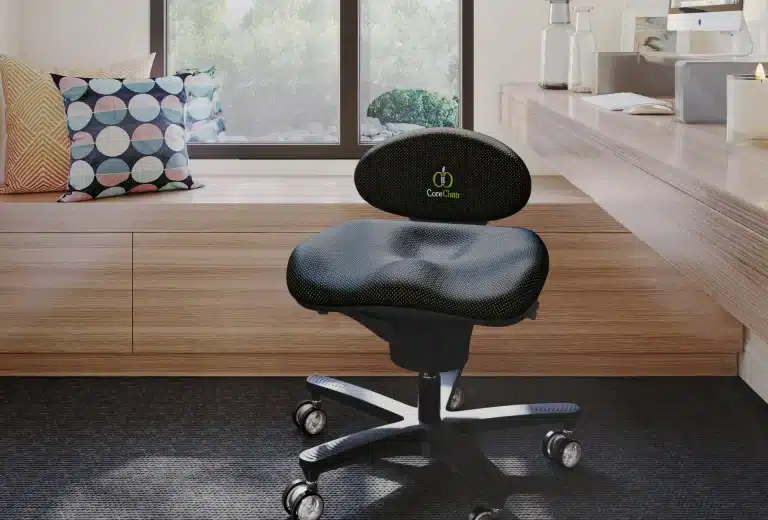
CoreChair is designed with a sculpted seat and patented movement base that naturally positions your pelvis in a neutral tilt. When your pelvis is aligned, your spine follows — stacking upright without muscular effort. This keeps your chest open, your shoulders back, and your ribcage free to expand fully with each breath.
This is not about forcing an artificial posture. It is about creating the conditions where good posture happens naturally, eliminating the compression that causes chest pain over time.
Continuous Micro-Movement Prevents Stiffness
One of the primary drivers of posture-related chest pain is stiffness — in the thoracic spine, the intercostals, and the pectoral muscles. Static sitting promotes this stiffness by keeping these structures locked in one position for hours.
CoreChair’s 360-degree movement base encourages continuous, gentle motion throughout the workday. This keeps your thoracic spine mobile, your chest muscles from tightening, and your ribcage moving freely. Research from the University of Waterloo confirmed that CoreChair increased trunk movement and muscle activation compared to both traditional ergonomic chairs and stability balls.
Reduced Sitting Pressure and Discomfort
Physical discomfort in any part of the body causes compensatory postural shifts – you unconsciously adjust your position to avoid the pain, often creating worse alignment and more chest compression. Cornell University research demonstrated that CoreChair distributes sitting pressure more evenly than high-end ergonomic alternatives, reducing the discomfort that triggers these harmful compensations.
The CoreChair Elite offers additional adjustability for users who require maximum customization for extended sitting sessions.
Improved Circulation and Recovery
Tight muscles need blood flow to recover. Static sitting restricts circulation, slowing the body’s ability to release tension in the chest wall and surrounding muscles. The University of Guelph study found that active sitting on CoreChair improved blood flow and cognitive performance — both of which support the body’s natural recovery from postural strain.
Practical Steps to Relieve Posture-Related Chest Pain
1. Switch to Active Sitting
Replace your static chair with a CoreChair to address the root cause. Active sitting prevents the forward collapse that compresses your chest, keeps your thoracic spine mobile, and supports natural breathing mechanics throughout the workday.
2. Stretch Your Pectorals Daily
Stand in a doorway with your forearms against the frame. Step forward gently until you feel a stretch across your chest. Hold for 30 seconds and repeat three times. This counteracts the shortening caused by hours of slouched sitting.
3. Mobilize Your Thoracic Spine
Sit on the floor with a foam roller positioned across your upper back. Support your head with your hands and gently extend over the roller. Move the roller to different segments of your thoracic spine and repeat. This restores the extension your mid-back loses during prolonged sitting.
4. Practice Diaphragmatic Breathing
Place one hand on your chest and one on your belly. Breathe in slowly through your nose, directing the air into your belly so that only your lower hand rises. Exhale fully. Practice for two minutes, three times throughout your workday. This retrains your breathing pattern and reduces the overuse of chest muscles.
5. Set Movement Reminders
Even with active sitting, brief standing breaks every 45 minutes help. Stand, reach your arms overhead, open your chest, and take five deep breaths. This resets the muscles and joints that contribute to chest tightness.
Stop Sitting Into Chest Pain
Sitting posture and chest pain are linked through simple, well-understood mechanics: compression, muscle shortening, restricted breathing, and spinal stiffness. The solution is not more stretching alone or periodic reminders to sit up straight -it is changing the fundamental way you sit.
CoreChair’s research-backed active sitting design keeps your chest open, your spine mobile, and your breathing unrestricted – addressing every mechanical pathway that connects poor posture to chest discomfort. Browse the full collection and see what real users report about the difference active sitting makes.
Your chest pain may not be coming from your heart. It may be coming from your chair.
Research and References
- Cornell University Pressure Mapping Study – Better weight distribution and comfort on CoreChair vs high-end ergonomic chairs.
- University of Waterloo Posture & Muscle Recruitment Study – CoreChair increased trunk stability, movement, and core muscle activation.
- University of Guelph Physiological & Cognitive Measures Study – Improved blood flow, cognitive performance, and movement on CoreChair.
- Memorial University Active Sitting Study – CoreChair promoted healthier sitting, improved blood flow, and reduced perceived back pain.
- Mayo Clinic NEAT™ Certification – CoreChair demonstrated measurable increases in daily energy output under NEAT™ guidelines.
- Biomechanical Benefits of Active Sitting (Leger et al., 2023) – Active chairs increase trunk movement, muscle activity, and postural variation.
- Active Sitting vs Traditional Sitting and Standing (Leger et al., 2022) – Active sitting improves circulation, muscle engagement, and energy expenditure.
- Active Sitting Increases Energy Expenditure (Davidson et al., 2025) – Significant increases in metabolism and oxygen consumption during active sitting.